The Complete 72-Hour Emergency Kit Checklist
A calm, practical checklist for getting your household ready for the first 72 hours: water, food, light and power, communication, first aid, hygiene, documents, the people and pets you look after, and evacuation bags. Work through it step by step and print the checklist at the end.
Published: Last updated: Reading time: 8 min read
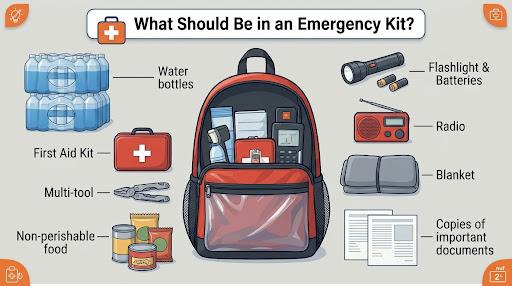
You do not need to buy everything at once. Start with what you already have, note what is missing and build your kit gradually. Each section below begins with a quick answer, followed by a checklist you can tick off and a few short explanations.
1. Drinking water and storage
Quick answer
4 litres per person per day (12 litres per person for 72 hours) is VITAL72's planning figure. Official recommendations differ by country and situation, so check the sources below for your region.
The 4-litre figure is a simple planning number chosen by VITAL72 to cover drinking and basic needs. It is not taken from any one authority. For a household of four, it adds up to 48 litres for 72 hours.
Official figures vary. Ready.gov (United States) advises at least one gallon of water per person per day for several days, for drinking and sanitation. The UK Be Ready checklist lists 3 litres per person per day for drinking and notes that more is needed for cooking and washing. The German BBK says an adult needs at least 1.5 litres of fluid per day, plus 0.5 litres of water if cooking.
Children, nursing mothers, sick people, people with medical needs and hot weather can all raise how much water is needed. Ready.gov also advises not rationing drinking water unless the authorities tell you to.
Commercially bottled water can be stored in its sealed original container. Ready.gov suggests replacing water that was not commercially bottled about every six months.
2. Emergency food supplies
Quick answer
Aim for at least three days of food that keeps without refrigeration and needs little or no cooking. Choose food your household already eats.
Three days is a starting point. The German BBK says that ideally you should be able to look after yourself for ten days, but that a supply for at least three days already helps a lot and can be built up step by step.
A living supply works well: buy one or two extra items on each shopping trip, eat the oldest first and replace what you use. Official sources suggest checking expiry dates regularly, from every six months to once a year.
3. Lighting and backup power
Quick answer
Keep a torch with spare batteries and a charged power bank where you can find them in the dark. Add warm layers, because homes can cool quickly when the heating stops.
The UK Be Ready checklist notes that torches are safer than candles. Keep your torch in a place everyone knows, not at the bottom of a box.
A power bank can charge phones and some medical devices during a power cut, but only while it holds charge. Recharge it regularly and check what it can power.
4. Communication equipment
Quick answer
A battery or wind-up radio, a power bank and a paper list of important phone numbers keep you informed and in touch if networks or the power fail.
Mobile networks can be busy or unavailable and phones need power. A radio can still bring you official updates. Write down the stations you use for news before you need them.
Agree one contact person outside your area whom everybody can reach, and a meeting point in case you cannot get home or reach each other.
5. First aid and essential medication
Quick answer
Keep a first aid kit and a supply of the medication your household relies on. Ask your doctor or pharmacist what is right for you.
This is general information only. Your doctor or pharmacist can tell you which medication and first aid items suit your household and how to store them. Do not start, stop or change medication because of this article.
Order repeat prescriptions in good time so that you are less likely to run out. Store medication safely, out of reach of children. Official sources also suggest learning basic first aid skills.
6. Hygiene and sanitation
Quick answer
Soap, wipes, bin bags and personal hygiene items help you stay clean when water or waste services are disrupted.
Keeping clean helps to reduce the risk of illness, so it is worth keeping up good hygiene even in an emergency. Hygiene also needs water, which is one more reason to store a little extra.
7. Important documents
Quick answer
Keep copies of your key documents together in a waterproof folder, and store a digital copy somewhere else. Make sure everyone knows where the folder is.
Documents can be hard to replace once lost. Ready.gov suggests keeping copies of important records either saved electronically or in a waterproof, portable container. The UK Be Ready campaign suggests keeping your household emergency plan with your passports, birth certificates and insurance policies.
Cash can be useful if electronic payments or cash machines are disrupted.
8. Children, elderly people and pets
Quick answer
Think about each person and animal in your household. Babies, older relatives and pets need their own supplies, and some people need extra help.
Talk through the plan with children in calm, simple words so they know what to expect. Write down medical needs and allergies for everyone in the household.
The UK Be Ready campaign suggests agreeing a backup plan with anyone who might need extra support, particularly if they live alone, and speaking to their neighbours. Ready.gov suggests considering the unique needs of your family, such as supplies for pets or seniors.
9. Emergency evacuation bags
Quick answer
Prepare one easy-to-carry bag for each person, packed with the basics for a few days away from home, and keep it near your exit.
An evacuation bag helps you leave quickly without having to think of everything under stress. A hands-free backpack is usually easier to carry than a suitcase.
Ready.gov suggests keeping supplies in one or two easy-to-carry containers. Check the bags twice a year: swap food and water, update clothes for the season and make sure medication and documents are current. Follow the advice of your local authorities about when and where to go.
Source: [1]
10. Printable 72-hour checklist
Quick answer
Print this one-page checklist, tick off what you have and keep a copy with your supplies. Adapt it to your household.
1. Drinking water and storage
2. Emergency food supplies
3. Lighting and backup power
4. Communication equipment
5. First aid and essential medication
6. Hygiene and sanitation
7. Important documents
8. Children, elderly people and pets
9. Emergency evacuation bags
Your ticks are not saved: they stay on this page only until you leave or reload it.
General guidance, not emergency instructions
This article offers general information to help you prepare. It is not medical advice and it is not an instruction for an emergency. In an urgent situation, call your local emergency number and follow the instructions of the emergency services and local authorities.
Emergency numbers
- 112EU, including Germany and Austria
- 999 or 112United Kingdom
- 911United States
Sources
These official pages were checked when this article was written. Official advice can change, so please check the current versions.
- 1.FEMA, Ready.gov (United States): Build A Kit (opens in a new tab)
- 2.FEMA, Ready.gov (United States): Water (opens in a new tab)
- 3.UK Government, Be Ready campaign: Be ready for emergencies (opens in a new tab)
- 4.BBK, Federal Office of Civil Protection and Disaster Assistance (Germany): Essen und Trinken bevorraten (opens in a new tab) (in German)
Keep learning
Make it personal
The My 72-Hour Plan tool, opened with the button at the bottom right of the screen, asks a few short questions and gives you a general checklist for your household. Your answers stay in your browser window.